
When it comes to rehabilitation exercises for injuries, one size does not fit all.
At TBHC, we always emphasize the importance of tailored advice, especially when it comes to managing pain and restoring movement. With a thorough assessment, your osteopath can pinpoint the root cause of your pain and determine which areas require treatment and rehabilitation. Additionally, they can identify any weaknesses, overactive muscles, or areas of excessive tension that may be contributing to your discomfort.
I know we always bang on about the need for specific advice and this is particularly true to rehabilitation exercises for a particular injury. With a thorough assessment, your osteopath will be able to identify where the pain is coming from, thus knowing which areas require treatment and rehab. They will also be able to connect the dots on which structures may have a weakness, or have too much tone, or may be overactive.
During your treatment the specific rehabilitation exercises for you will be demonstrated in person and you will be asked to perform them as well in the treatment room. This is to ensure you fully understand the exercises and can report back any feedback you feel whilst performing them. It is crucial that the exercises are completed effectively and safely. Ongoing reviews of your presenting injury and rehabilitation exercises will take place to ensure progress is continually being made. Your body needs to be challenged in a safe and controlled way to ensure progress and gains are made. And on the contrary, if an exercise isn’t giving the desired results, it may need to be modified or changed.
To strengthen the shoulder complex, we at Total Balance Healthcare like to start out by focusing on two main (and simple) components:
Rotator Cuff strength – the rotator cuff (RC) is a group of muscles which surround your glenohumeral joint and activate movement of the shoulder. The rotator cuff comprises of supraspinatus, infraspinatus, subscapularis and teres minor.
Scapula (shoulder blade) control – to allow the rotator cuff to work efficiently during motion, and to avoid impingement due to narrowing of the shoulder joint space, the scapular needs to be controlled and positioned effectively.
With all joints in the body it is important to get the ideal balance between joint mobility and stability. Here are some simple exercises that we commonly prescribe to patients in the clinic, and you can do at home, to help with shoulder discomfort.
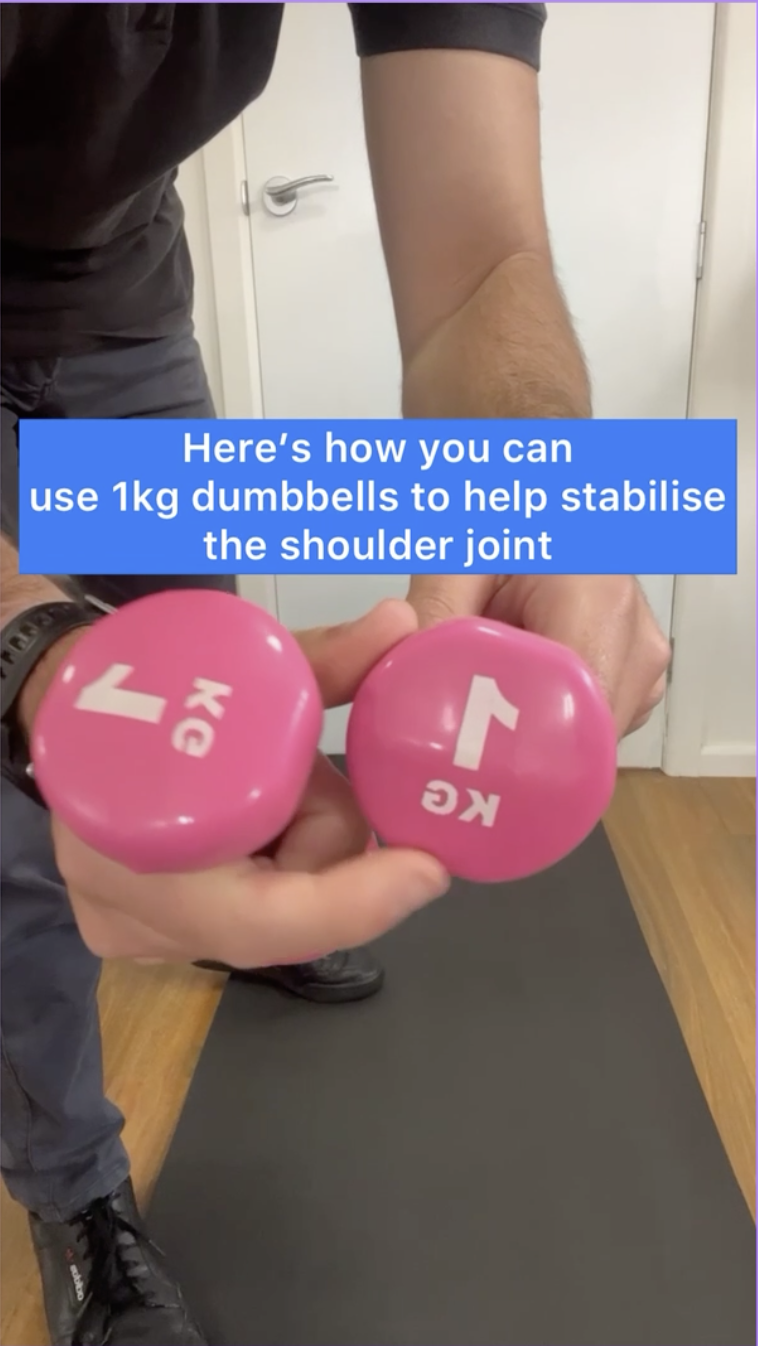
1. SHOULDER STABILITY EXERCISES WITH 1KG DUMBBELLS
In the below video our osteopath James demonstrates some simple exercises which will help to stabilise the shoulder joint in internal rotation and external rotation. By using the light weight and going through a range of motion you are comfortable in, this exercise is great to get the muscles and tendons of the shoulder complex working.
The next four exercises we are going to discuss can be performed at home with light weights and resistance bands. James has demonstrated these exercises in the below video.
2. DUMBBELL SHOULDER EXTERNAL ROTATION
This exercise can be done seated, standing or in a side lying position. In the video, James has performed this exercise side lying and with a towel under his arm, this is in order to isolate the movement to the shoulder joint. At a starting level you perform 3 sets of 12 reps, with a 1-4kg dumbbell. You may need to increase the load depending on your base level.
3. RESISTANCE BAND W’S
This exercise utilises a theraband/resistance band. Here we are working on shoulder external rotation as well as scapular retraction. Perform 10-15 reps, 3 times per day.
4. FRONT RAISES WITH DUMBBELL (EITHER DYNAMIC OR ISOMETRIC MOVEMENT)
Using a dumbbell you can perform a front raise, as demonstrated in the video. By moving your arm up and down in front of you, you are performing a dynamic movement which is great for muscle strength. By holding your arm in the one position in front of you, isometric, you are working more on shoulder stability. Aim to swap the movements between the sides, to work both elements of shoulder strength and stability.
5. FRONT RAISES WITH RESISTANCE BAND
By adding in the resistance band you are activating the rotator cuff and adding a bit of a challenge. Aim to maintain the tension of the resistance band as you work through the motion. This exercise can be done just with a theraband to start off with and dumbbells can be added as you progress.
These exercises are just general advice and if you are experiencing pain or discomfort of any sort, please seek the guidance of a health professional in order to get the most specific advice for you and your presenting complaint. Please do not hesitate to contact our team of osteopaths at the clinic on 9773 8085 if you have any questions at all. Online bookings are easy to make through the website if you would like to get started on your treatment journey with one of our osteopaths.
✌️
The Team @ Total Balance
LET’S GET SOCIAL!!!!


This blog post is an educational tool only. It is not a replacement for medical advice from a registered and qualified doctor or health professional.
Phone: (03) 9773 8085


